
So, I bought this flute piece from Latin America. Now what?
Excellent! We’re so happy to hear this, and hope that the following leads to an informed performance of the piece that you purchased. To begin, we need to introduce you to what we call the “when, where and who” concept. Though you could apply this approach to European or US compositions, in Latin America, classical music developed much less uniformly, such that three things are critically important: when a given piece was composed, where it was composed and who composed it, all in order to determine the best way to perform it. To better illustrate this principle, we’ve selected three pieces from our catalog for flute and piano that we hope will provide you with some helpful pointers. Let’s start with the oldest piece, Adieu à la Havanne, which was written by Cuban composer José Comellas sometime before 1874. 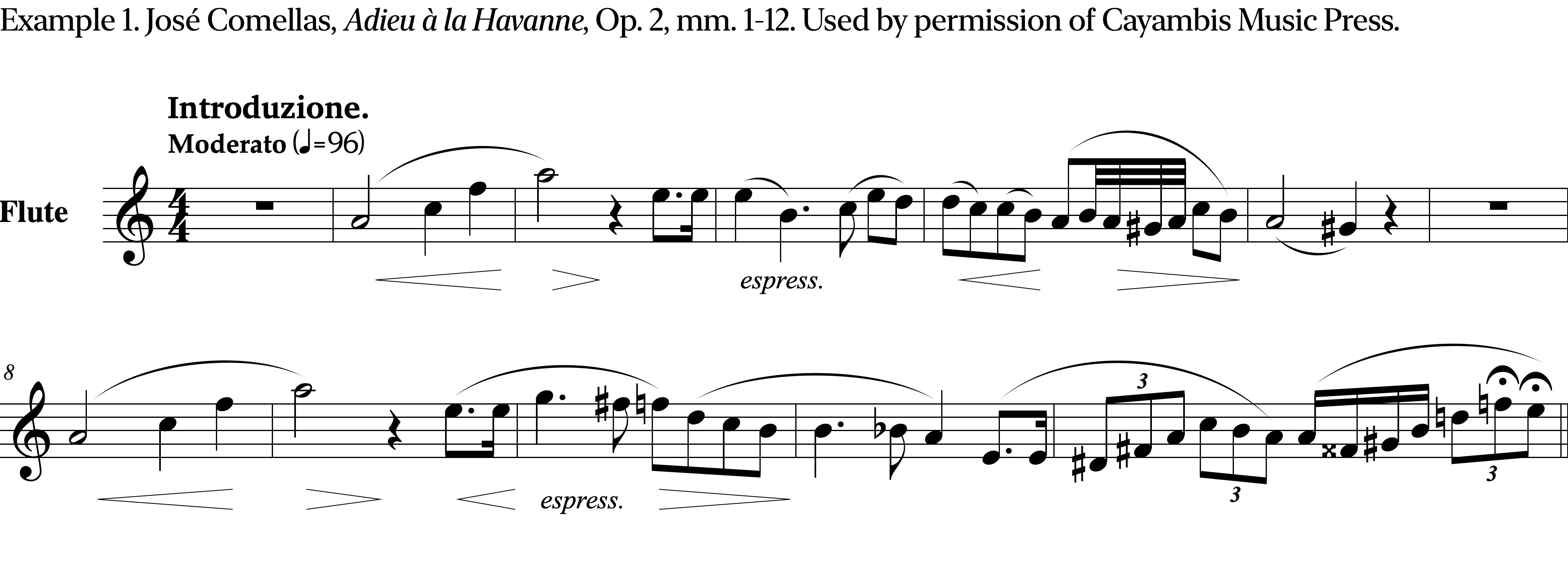 Irrespective of the fact that accompanied solo pieces for instruments—other than those for the violin—were quite rare in Latin America during the latter three decades of the 19th century, the most important stylistic consideration for a piece like this is that it’s very similar to any other mid-19th composition of its genre from either Europe or the US. At the same time, because opera was one of the most important forms of entertainment throughout Latin America, there are plenty of examples of accompanied solo pieces—again, mainly for violin—that were based on favorite opera arias. In other words, despite having been composed by a Latin American, there is no reason that would compel you to treat this piece any differently simply because of the nationality of its author. However, by the mid-20th century things had substantially changed, to the point where we have to start talking about national styles; that is, how the preferred compositional characteristics in one country might be very much different from those of its neighboring country or countries. In 1945, American flutist, composer and conductor David Van Vactor (1906-94) was invited to visit Chile, where he directed concerts of chamber music, taught classes in that country’s conservatory, and performed or conducted several times. Soon after his arrival, the conservatory’s director, René Amengual (1911-1954), composed a four-movement suite for flute and piano for the US musician. 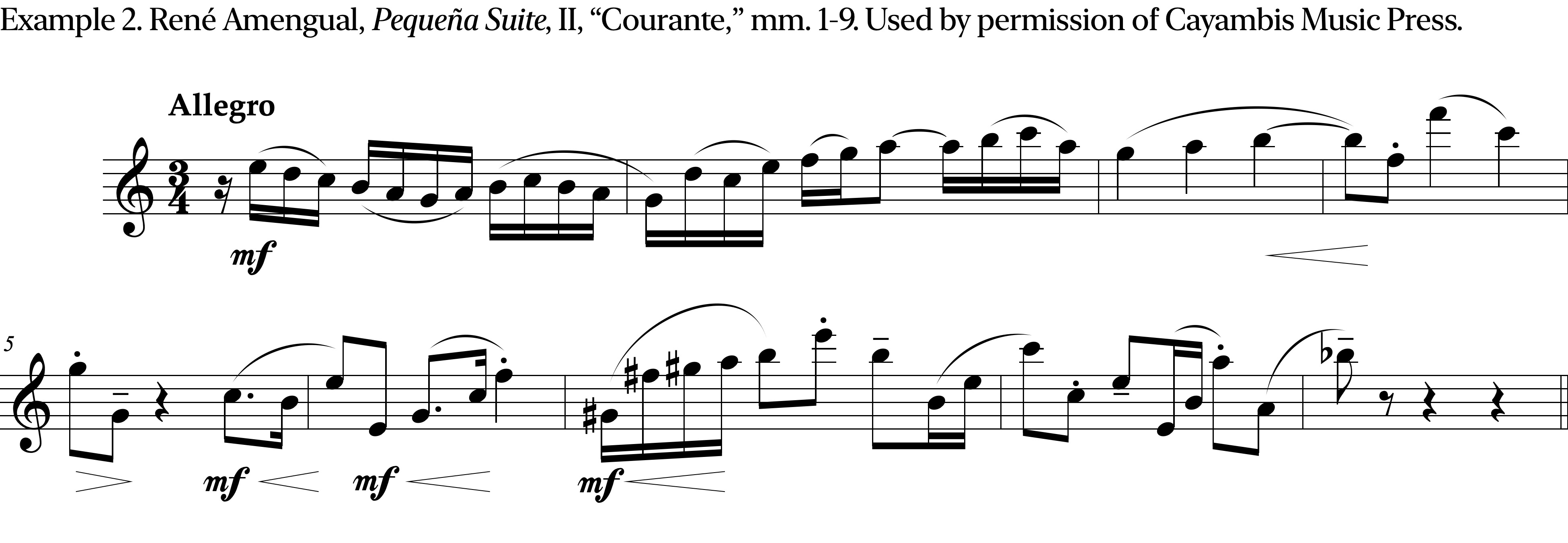 A number of years earlier, in 1924, one of the most important Chilean composers of that time, Domingo Santa Cruz (1899-1987), founded the Sociedad Bach, which not only promoted reform in that country’s conservatory, but also, his group served as a catalyst for the development of a kind of neo-classicism concerned mostly with formal structure. Stylistically, however, much of the music composed in Chile during that time reveals a strong affinity for French impressionism. (In this way, Chile’s classical music is remarkably different from that of any other Latin American country). Meanwhile, composers, principally in Ecuador and Peru, had begun to develop a “proto-Andean” compositional style based on two elements, one imaginary, and the other, more genuine. On the one hand, the composers in these countries had become convinced that the indigenous music of their region, before the Spanish Conquest, had been based on pentatonic scales that had been brought to their shores from Asia. (The word scale is a European term that refers to the hierarchical relationship between pitches in an ascending or descending order. We have no way to determine if a similar sort of relationship existed in the music of pre-Conquest Ecuador or Peru). Actually, although we only have textual descriptions of the music that was heard by the Spanish chroniclers, there’s reason to believe that today’s Andean folk songs, such as the sanjuanito, huayno, yaraví, and others, might have been passed down from generation to generation, in a relatively unaltered fashion. At the same time, Andean history and mythology have become increasingly important as sources of inspiration for the composers of this region. Since the late 19th century, for example, there have been many musicalizations of the story of Atahaulpa, who was the Incan emperor at the time of the Spanish Conquest. Ecuadorean composer Leonardo Cárdenas’ En el centro del mundo y el tiempo, reveals both of these tendencies.  On the one hand, the subtitle of each movement references folk songs still sung throughout Ecuador. There is also a persistent use of modal-like scales in which the third and seventh are both lowered. This is in keeping with a prevailing attitude in the Andes, which is that the minor scale naturally and best represents the somberness of the Andean personality. Furthermore, this work is replete with mordents, descending grace note figurations and other scalar or rhythmic effects that are suggestive of the quena, which is the keyless, flute-like instrument made out of bamboo that was performed by Incan musicians. On the other hand, recent research suggests that the indigenous people living in the area around present-day Quito were aware of how their community was situated in the center of the world, which today would be interpreted as being on the equator.  This work, which won the NFA Newly Published Music award in 2023, is a substantial work. Lasting approximately eighteen minutes, this grade five composition would make for an impressive featured piece on a recital program.  |