
Performing Latin American music for flute: a few observations
We want to get young musicians interested in the classical music of Latin America, while at the same time, enriching the catalog of fine recordings that we upload to our website. With these goals in mind, we recently launched a performance competition around three works for flute and piano, and to make it even more enticing, students, 16 to 21 years old, can even win a cash prize of $500.
By now, most of you surely know that Latin America’s classical music, with its many styles, is extraordinarily rich and diverse; and, as it turns out, the three pieces that we chose for this competition perfectly demonstrate these characteristics. Because of this, we thought that it would be helpful to write a short article about these pieces and some of the interpretative challenges that they present to the performer. Before continuing with our observations, however, we’d like to insert a short disclaimer, which is that our observations are not meant to be either complete or exhaustive; nor, are they intended to exclude any other reasonable interpretative approach to these compositions.
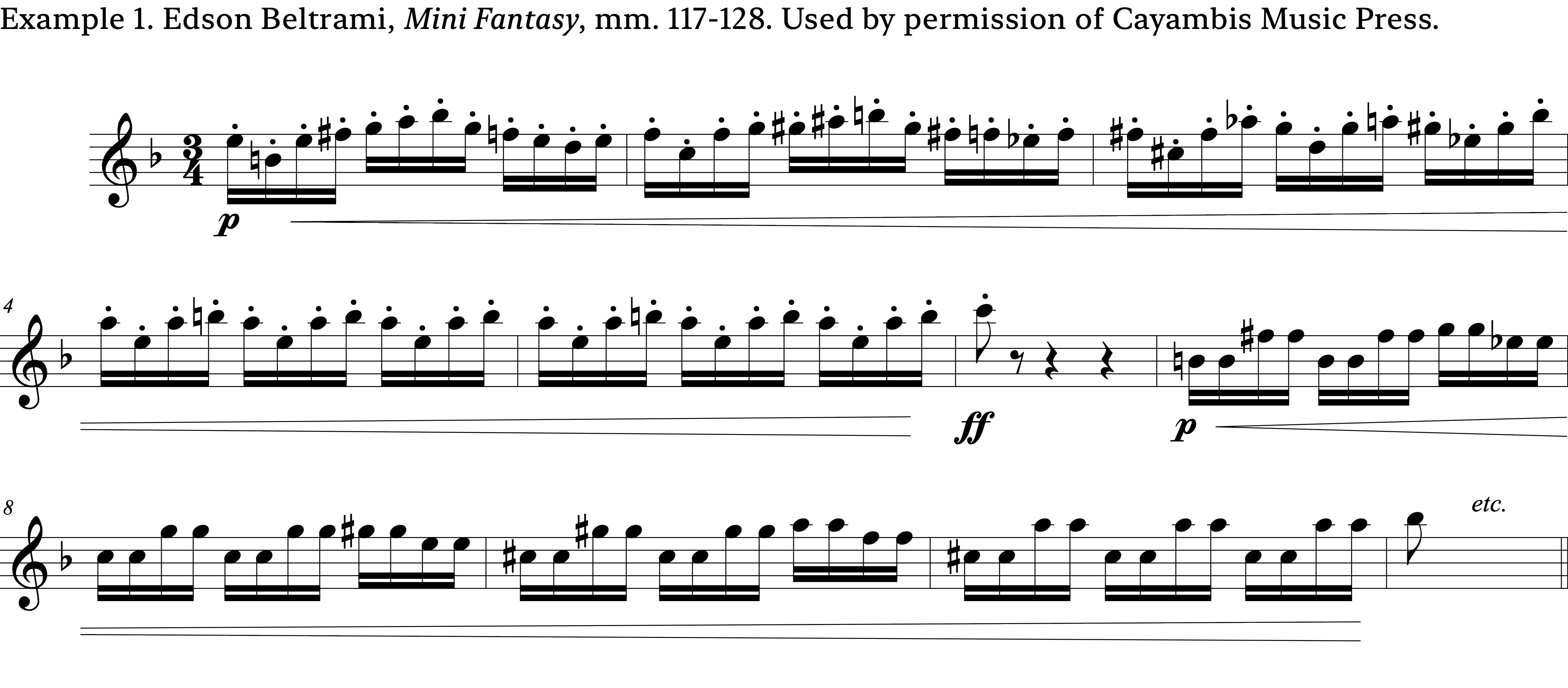
Although we sometimes expect something distinctively Latin American to just jump off the page, the truth is, a good amount of Latin America’s classical music can be said to be stylistically indistinguishable from that of any other country or region. Case in point: Brazilian composer Edson Beltrami’s Mini Fantasy. Indeed, many of his compositions for wind instruments reveal an affinity for American jazz. It should also be noted that Beltrami himself is a fine flute player. Yet, although this work is moderately virtuosic, its challenges should not be underestimated.
In our opinion, the contrast between different types of articulation plays an important role in this piece, particularly as these pertain to the importance of maintaining melodic direction. Compare, for example, these two adjacent passages from near the end of the work:
Jose Lezcano’s Postcards reveals an underlying structure akin to that of a three-movement Baroque concerto. Known today as neo-Classicism, this style began to appear in Latin American composition during the early part of the 20th century, but particularly in Chile. At the same time, however, but on a larger scale, certain quasi-impressionistic elements began to be incorporated, not only in Chile, but in other countries as well. Because of this, it is important to ask, to what extent do the subtitles in this particular Cuban-American work influence one’s interpretation of its first two movements? Furthermore, a much denser accompaniment (than that of the Beltrami work) may require that the flutist should perhaps cultivate a much more robust sound, particularly in the second movement. 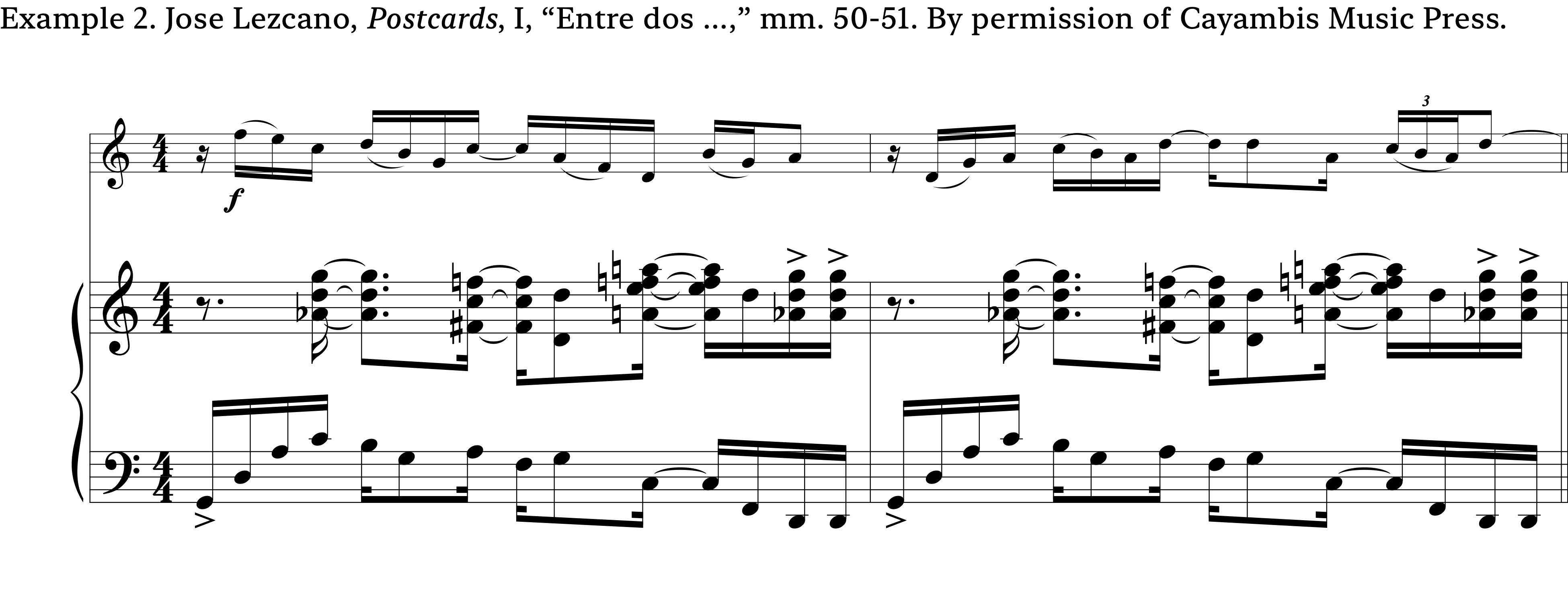
Of these three concert pieces, the one that can be most accurately described as folkloric is by Venezuelan composer Luis Pérez Valero. This work is inspired by a Zulian dance which is found in the northwestern region of that country. You might want to listen to the audio track below. In cases of folkloric influence, be sure to listen to rhythm and melodic shape, which are some of the most distinguishing characteristics regarding this kind of music.
However, please keep in mind that “inspired” may not necessarily mean “transcribed.” 
Good luck in your preparation! We‘re looking forward to having some really fine recordings of the music that we publish. And maybe one of those will be yours!
 |